

Heat Seal Tester Ultrasonic Inspection System
Features
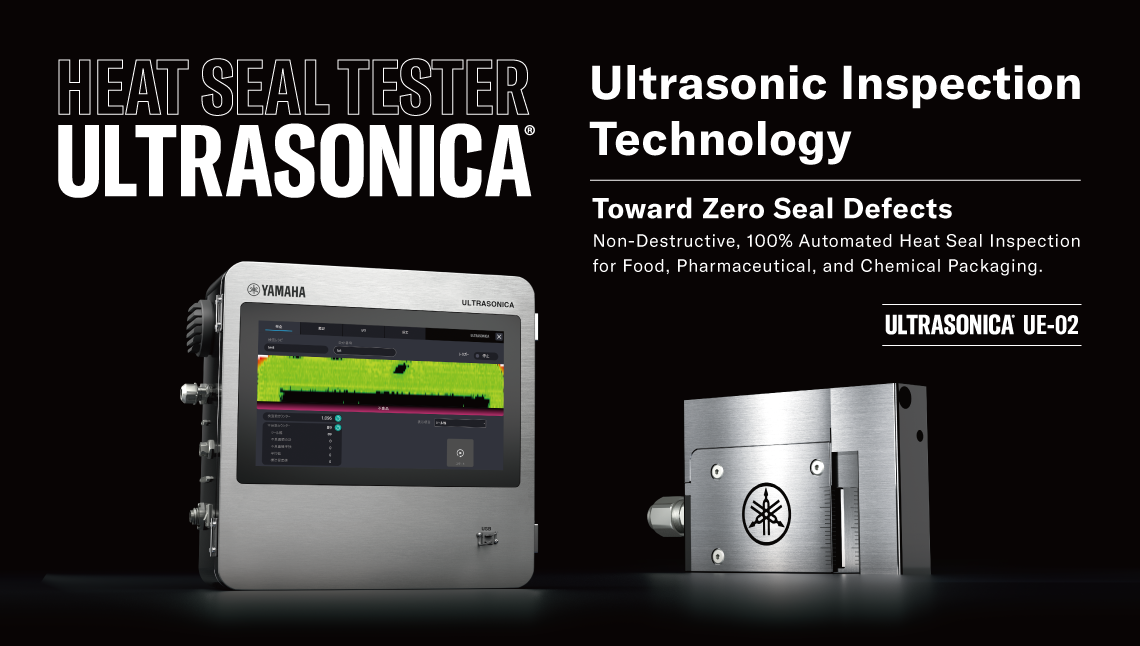
Powered by Yamaha's Sound Expertise ULTRASONICA®
Heat seal defects such as internal delamination and air bubbles cannot be detected by visual or camera inspection, while conventional sampling and destructive testing fail to ensure full quality assurance-leaving a constant risk of market recalls and brand damage.
Against this backdrop, ULTRASONICA® -an ultrasonic camera from Yamaha's sound expertise-was created.
Proprietary airborne ultrasonic sensors and acoustic signal processing enable visualization of the internal condition of heat seals, allowing for non-destructive, non-contact, in-line 100% automated inspection.
Quantify and visualize seal quality to enable truly objective inspection, clarify release criteria, and reduce the risk of defects reaching the market. With traceable data, ULTRASONICA® enhances audit readiness and quality accountability.
Against this backdrop, ULTRASONICA® -an ultrasonic camera from Yamaha's sound expertise-was created.
Proprietary airborne ultrasonic sensors and acoustic signal processing enable visualization of the internal condition of heat seals, allowing for non-destructive, non-contact, in-line 100% automated inspection.
Quantify and visualize seal quality to enable truly objective inspection, clarify release criteria, and reduce the risk of defects reaching the market. With traceable data, ULTRASONICA® enhances audit readiness and quality accountability.
Defect Escape Prevention
Accuracy
Industry-first ultrasonic heat seal inspection with a line sensor. Powered by Yamaha's acoustic signal processing, it achieves exceptional sensitivity and visualizes previously undetectable defects-regardless of packaging color or material. Non-destructive, non-contact, in-line 100% automated inspection prevents defect escape.
![[ Image ] Innovative Ultrasonic Camera](./file/1080/heatsealtester_img02.jpg)
Innovative Ultrasonic Camera
Intelligent Judgment Function
Stability
ULTRASONICA® features up to six inspection judgment functions, tailored to packaging types and product specifications, enable flexible detection of various seal defects. Combined multi-judgement functions suppress false positives, preventing unnecessary rejects and yield loss. With conveyor speeds of up to 60 m/min, it ensures stable quality control and efficient production even on high-speed lines.
![[ Image ] Flexible Judgment Functions](./file/1073/heatsealtester_img03.jpg)
Flexible Judgment Functions
Image-Based Quality Assurance
Reliability
Ultrasonic technology clearly visualizes seal conditions as images, enabling intuitive identification of defect location, size, and shape-previously detected only through numerical data or graphs. All results are recorded as image data, ensuring full traceability. This supports robust quality assurance, builds customer trust, and enables root cause analysis and continuous improvement.
![[ Image ] Visualization of Seal Quality](./file/1196/heatsealtester_img04.png)
Visualization of Seal Quality
Visualizing Seal Conditions with Airborne Ultrasonic Technology
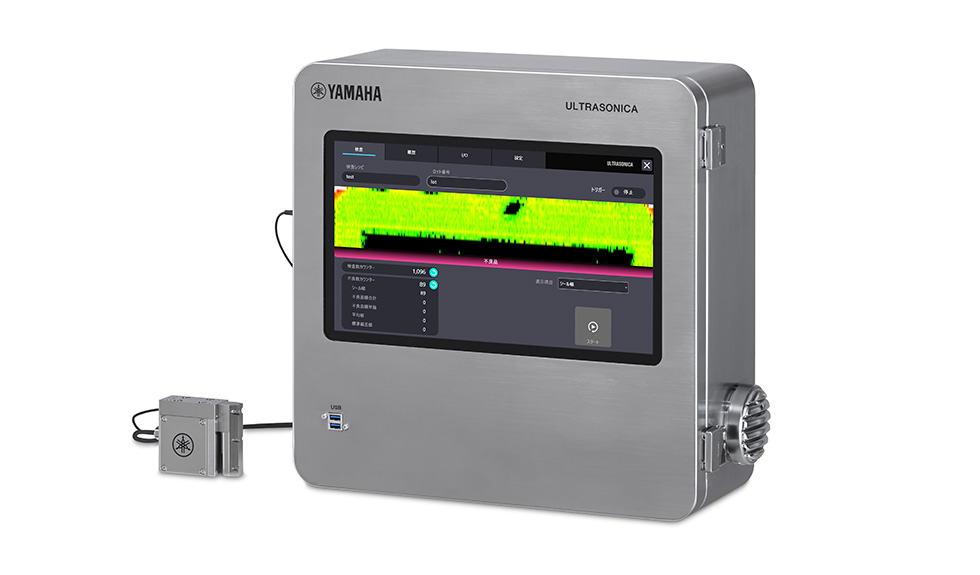
As packages pass through the ultrasonic sensor head, seal conditions up to 20 mm in width are visualized as images.
Using an inspection principle based on variations in ultrasonic signal intensity, it detects packaging defects that are difficult to identify visually including in aluminum laminates and printed films.
Using an inspection principle based on variations in ultrasonic signal intensity, it detects packaging defects that are difficult to identify visually including in aluminum laminates and printed films.
![[ Image ] Ultrasonic Sensor Head](./file/1198/heatsealtester_img27.png)
Ultrasonic Sensor Head
![[ Image ] Judgment Screen & Inspection Images](./file/1197/heatsealtester_img28.png)
Judgment Screen & Inspection Images
Easy Setup
- No specialized skills, experience, or certifications required
- Intuitive operation via touchscreen and user-friendly interface
- Easy recipe creation for configuring pass/fail criteria
![[ Image ] Easy Setup](./file/1056/heatsealtester_img05.jpg)
Flexible Installation
- Ultra-compact sensor fits into limited spaces
- High installation flexibility across various processes
- No major modifications required for layout changes
![[ Image ] Flexible Installation](./file/1223/heatsealtester_img06.png)
Stable Operation
- Reduced setup time contributes to stable production
- Low running costs with no periodic replacement parts
- Easy daily checks, setup, and maintenance
![[ Image ] Stable Operation](./file/1199/heatsealtester_img07.png)
Data Utilization
- All packages can be recorded as numerical data
- Supports predictive maintenance of production equipment
- Monitors daily and monthly defect counts and trends
![[ Image ] Data Utilization](./file/1059/heatsealtester_img08.jpg)
Defect Patterns
![[ Image ] Good](./file/1214/heatsealtester_img29.png)
![[ Image ] Incomplete Sealing](./file/1204/heatsealtester_img30.png)
![[ Image ] Wrinkles / Creases](./file/1217/heatsealtester_img31.png)
![[ Image ] Skewed / Misaligned](./file/1206/heatsealtester_img32.png)
![[ Image ] Fold-In](./file/1218/heatsealtester_img33.png)
![[ Image ] Pinholes](./file/1220/heatsealtester_img34.png)
![[ Image ] Insufficient Width](./file/1215/heatsealtester_img35.png)
![[ Image ] Double Feeding](./file/1212/heatsealtester_img36.png)
![[ Image ] Entrapment (Flour)](./file/1216/heatsealtester_img37.png)
![[ Image ] Entrapment (Bonito Flakes)](./file/1211/heatsealtester_img38.png)
![[ Image ] Entrapment (Nonwoven)](./file/1221/heatsealtester_img39.png)
![[ Image ] Over-Sealing](./file/1208/heatsealtester_img40.png)
Application Examples
Supports Various Seal Positions and In-Machine Installation
Examples of Inspectable Packaging
Top Seal
![[ Image ] Top Seal](./file/1207/heatsealtester_img41.png)
Center Seal / Vertical Seal
![[ Image ] Center Seal / Vertical Seal](./file/1209/heatsealtester_img42.png)
Top Seal
![[ Image ] Top Seal](./file/1203/heatsealtester_img41sp.png)
Center Seal / Vertical Seal
![[ Image ] Center Seal / Vertical Seal](./file/1201/heatsealtester_img42sp.png)
Examples of Applicable Processes
Rotary Pouch Filling Machines
![[ Image ] Rotary Pouch Filling Machines](./file/1200/heatsealtester_img43.png)
Form-Fill-Seal Machines
![[ Image ] Form-Fill-Seal Machines](./file/1210/heatsealtester_img44.png)
Automatic Sealing Machine
![[ Image ] Automatic Sealing Machine](./file/1202/heatsealtester_img45.png)
Aligning Conveyor
![[ Image ] Aligning Conveyor](./file/1213/heatsealtester_img46.png)
Horizontal Form-Fill-Seal Machine
![[ Image ] Horizontal Form-Fill-Seal Machine](./file/1219/heatsealtester_img47.png)
Vertical Form-Fill-Seal Machine
![[ Image ] Vertical Form-Fill-Seal Machine](./file/1205/heatsealtester_img48.png)
Applicability by Packaging Type and Material
Inspection feasibility may vary depending on packaging specifications and conditions, even for the cases below as reference examples.
| Inspectable | Examples |
|---|---|
| Plastic Films / Laminated | Transparent, white opaque, printed, light-shielding, and colored pouches, etc. |
| Metal-Based High-Barrier | Aluminum vapor-deposited, foil laminates, transparent barrier pouches, etc. |
| Paper, Nonwoven, and Fibers | Eco-friendly paper, nonwoven and mono-layer paper pouches, etc. |
| Non-Inspectable | Examples |
|---|---|
| Multi-Layer / Multi-Seal | Top/end & center overlaps, gusseted pouches, kraft/PE double-layer bags, etc. |
| Formed or Rigid Containers | Spouted pouches, tray/cup seals, blister packs, thermoformed containers, etc. |
| Without Seal Areas | Shrink, sleeve, and skin packaging, etc. |
FAQ
- What types of seal defects can ULTRASONICA® detect?
- ULTRASONICA® can detect various seal defects, including delamination, pinholes, wrinkles, folds, seal misalignment, foreign material in the seal area, and weak seals.
Detection capability and accuracy may vary depending on the packaging material, seal width, product contents, conveying method, and the size and location of the defect. Please confirm detection performance through our package sample testing service. - Can ULTRASONICA® detect seal defects that are difficult to see?
- Yes. ULTRASONICA® uses airborne ultrasound technology to visualize the internal condition of heat seals, even through opaque packaging materials.
It enables the detection of defects that may be missed by human visual inspection or camera-based inspection systems. - Is the package opened, pressurized, or immersed in water during inspection?
- No. The package is not opened, pressurized, or immersed in water during inspection.
ULTRASONICA® uses airborne ultrasound to inspect the sealed area non-destructively.
It can be integrated into packaging machines or installed on conveyor lines, making it suitable for applications ranging from in-process inspection to final inspection before shipment. - What types of packaging can be inspected?
- ULTRASONICA® can inspect seals made from a variety of materials, including transparent or printed plastic films and aluminum-based packaging materials.
It has been widely used to inspect top seals on pouches and center seals on pillow packages.
Inspection may not be possible for seal areas where three or more layers of film overlap, rigid containers, or packages without a suitable sealed area. - Can ULTRASONICA® perform 100% inspection on a production line?
- Yes. ULTRASONICA® is designed for 100% automated inspection on production lines and can be integrated with packaging machines or conveyor systems.
Installation feasibility depends on the specifications of the packaging machine and the conveying conditions. We will recommend a suitable configuration after reviewing factors such as package orientation, spacing, line speed, seal area, and available sensor installation space.
The system can also be integrated with a reject mechanism to automatically remove defective products from the line. - Can ULTRASONICA® be retrofitted to an existing packaging machine?
- Retrofit feasibility depends on the packaging machine specifications, available installation space, and line conditions. Please contact your packaging machine manufacturer first.
- What is the smallest defect that can be detected?
- Defects as small as φ1.0 mm can be detected.
Detection capability and accuracy may vary depending on the packaging material, seal width, product contents, conveying method, and the size and location of the defect. Please confirm detection performance through our package sample testing service. - Can inspection results be saved and reviewed?
- Yes. ULTRASONICA® can save inspection images and inspection results.
Under standard operating conditions, approximately 3 million inspection results can be stored. The actual number varies depending on the inspection settings and the data being saved.
For long-term storage of larger amounts of data, we recommend using an external storage device.
Saved data can be used for root cause analysis, process improvement, and quality control. - Can ULTRASONICA® detect changes in seal condition?
- Yes. ULTRASONICA® quantifies seal condition, making it possible to identify weak seals and changes in sealing quality.
By monitoring trends in inspection data, changes in seal condition can be identified and used to support preventive maintenance.
Detection capability and accuracy may vary depending on the packaging material, seal width, product contents, conveying method, and the size and location of the defect. Please confirm detection performance through our package sample testing service. - Can I evaluate actual packaging samples before installation?
- Yes. We can evaluate inspection feasibility and defect detection performance using your actual packaging samples.
Both good and defective samples are required for sample testing. If you would like to request an evaluation, please contact us using the inquiry form below.
Sample Testing
Free Testing of Your Samples
For customers considering our inspection system, we offer free sample testing to evaluate inspection performance in advance. Detection accuracy varies depending on packaging format, materials, and sealing conditions, so we recommend prior evaluation using actual samples. By sending both good and defective samples, you will receive a sample test report confirming the detectability of seal defects.
Introduction Process
- Inquiry
- Requirements Review
- Sample Testing
- Delivery & Training
Eligible Product for the Japanese SME Labor-Saving Investment Subsidy
![[ Image ] Subsidy rate:up to 50%](./file/1222/heatsealtester_img49.png)
Winner of the Category Excellence Award at the JAPAN PACK AWARDS 2025.
![[ Image ] JAPAN PACK AWARDS 2025](./file/1181/heatsealtester_img50.png)